We research gear rather than testing it, and some links below are Amazon affiliate links — if you buy through one we may earn a commission, at no extra cost to you. It does not change what we recommend. Full disclosure.
In this article(7 sections)
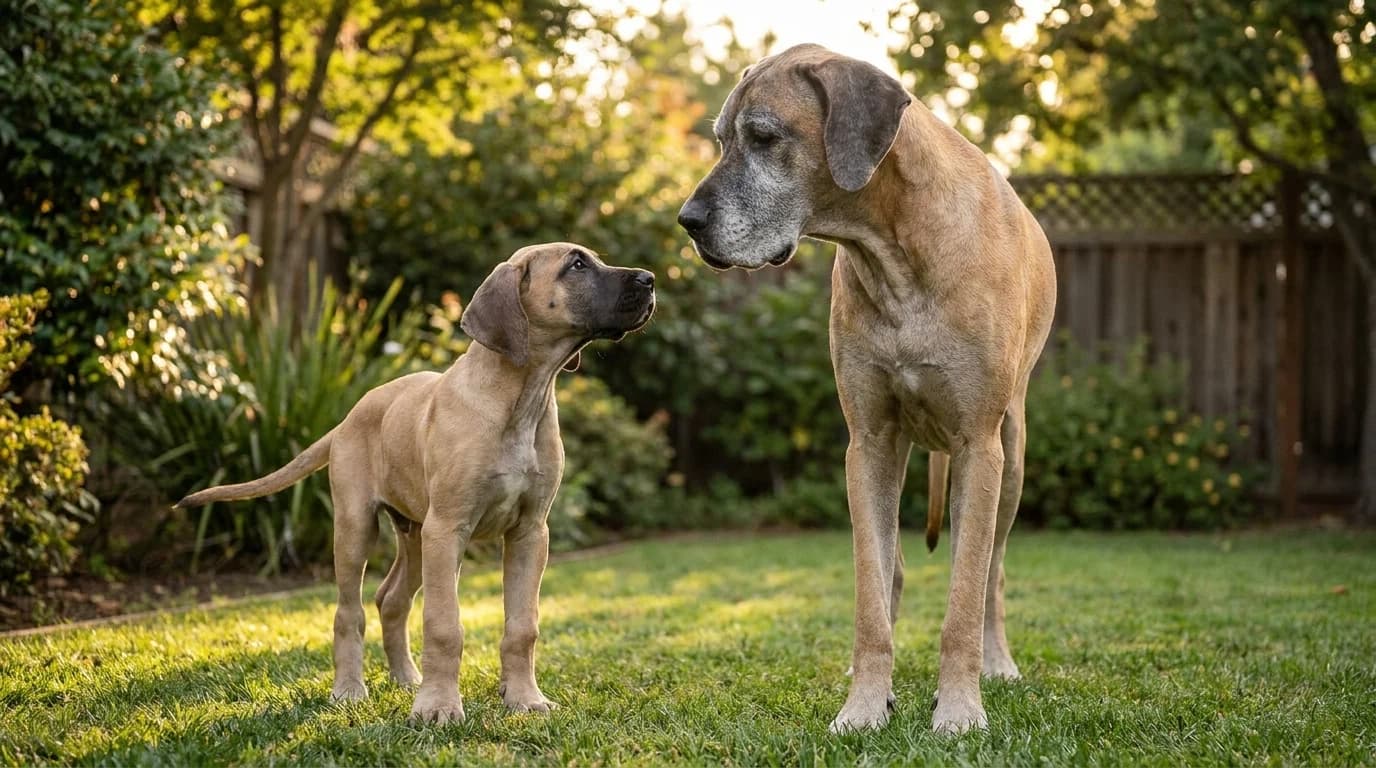
Most puppies finish growing between six months and two years, and adult size decides where in that window yours lands. So the useful question is not how old your puppy is but how big it will be, and this guide is organised that way. It belongs to the puppy stage, where most of the growing happens.
The growth timeline by adult weight
The American Kennel Club publishes a puppy growth chart by percentage of adult size, split into four adult-weight classes. AKC marks every figure as approximate.
| Adult weight class | 6 months | 9 months | 12 months | 15 months | 18 months |
|---|---|---|---|---|---|
| Small (0–20 lb) | 75% | 90% | 100% | 100% | 100% |
| Medium (21–50 lb) | 66% | 85% | 95% | 100% | 100% |
| Large (51–100 lb) | 60% | 75% | 85% | 95% | 100% |
| X-Large (100+ lb) | 50% | 65% | 80% | 90% | 100% |
At six months an extra-large puppy is about half grown, while a small dog is three-quarters of the way there. The chart starts at six months, so it cannot say when smaller puppies passed halfway, only that they had.
Rule of thumb: The bigger the adult, the longer the growth, and the smaller the share that is finished on any given birthday.
When each size is done: what vets say
AKC and VCA Animal Hospitals give ranges, and they overlap because "stops growing", "adult size" and "adulthood" are different finish lines.
| Size | Stops growing (AKC) | Reaches adult size (VCA) | Considered adult (VCA) |
|---|---|---|---|
| Small | Typically by 6 to 8 months | 6 to 12 months, very small dogs at the early end | 10 to 12 months; 6 to 8 for really small dogs |
| Medium | Around 12 months | Not given | Around a year |
| Large | Not given | Most between 12 and 18 months | 18 to 24 months |
| Giant | 12 to 18 months; Mastiffs may need 24 | Some, such as Mastiffs, around 2 years | 18 to 24 months |
Two wrinkles: AKC's chart has extra-large dogs fully grown by 18 months, while the same article says Mastiffs may need 24. And AAHA ends the puppy stage when rapid growth stops, around six to nine months depending on breed and size; slower growth continues past it. The dog age calculator gives your dog's stage alongside its age.
Taller, heavier, finished: three separate finish lines
Height stops when the growth plates close
The long bones of the legs grow from growth plates, soft zones that make new tissue through puppyhood. Dr. Jerry Klein, AKC's chief veterinarian, explains that once they stop producing tissue and fully calcify, they have closed and the bone is at its final size. AKC's rough line is that most puppies stop getting taller by 12 months, while large and giant breeds may keep developing to 18 to 24 months.
A rib check for mixed breeds
Dr. Klein's tip for a dog of unknown heritage: run your hands down the rib cage. If you can still feel the knobs of the ribs, which are growth plates, the dog will probably keep growing in height.
Filling out comes last
After skeletal growth ends, AKC notes that young dogs keep developing muscle and body fat. Regular weigh-ins plus body condition checks, which VCA recommends throughout growth, tell healthy filling out from surplus.
 Height ends when the growth plates close; weight and muscle keep changing after that, which is why the scale stays useful.
How big will my puppy get?
No formula guarantees an adult weight. The growth-chart method described by the WALTHAM Petcare Science Institute and a Royal Canin Academy article for vet teams starts from an estimate and lets the puppy correct it:
- Start from the best estimate you have. The breed's expected adult weight, or the parents' weights if they are in ideal body condition, per Royal Canin Academy.
- Pick the matching chart. WALTHAM publishes 14 growth charts, male and female across seven size groups, validated from 12 weeks of age.
- Weigh often. Royal Canin Academy suggests every two weeks at minimum and weekly at best, at the same time of day, since meals and hydration shift the number.
- Let the curve correct you. A few plotted weights show which percentile line the puppy follows, and WALTHAM says you can switch charts if the first size guess was wrong.
The limits:
- Mixed breeds start as a best guess. Royal Canin Academy advises guessing, then placing the puppy by its first recorded weights; Dr. Klein calls it "a bit of a guessing game".
- Giant breeds resist a single curve. The 2017 PLOS ONE study that built these growth standards could not fit one curve to giant breeds, because Great Danes and Mastiffs grew differently from each other. VCA tells giant-breed owners to ask their vet for an appropriate curve.
- A percentile is not a grade. Royal Canin Academy reports that healthy dogs rarely leave their original percentile line, while dogs that were obese by age three had usually grown faster and crossed two or more lines.
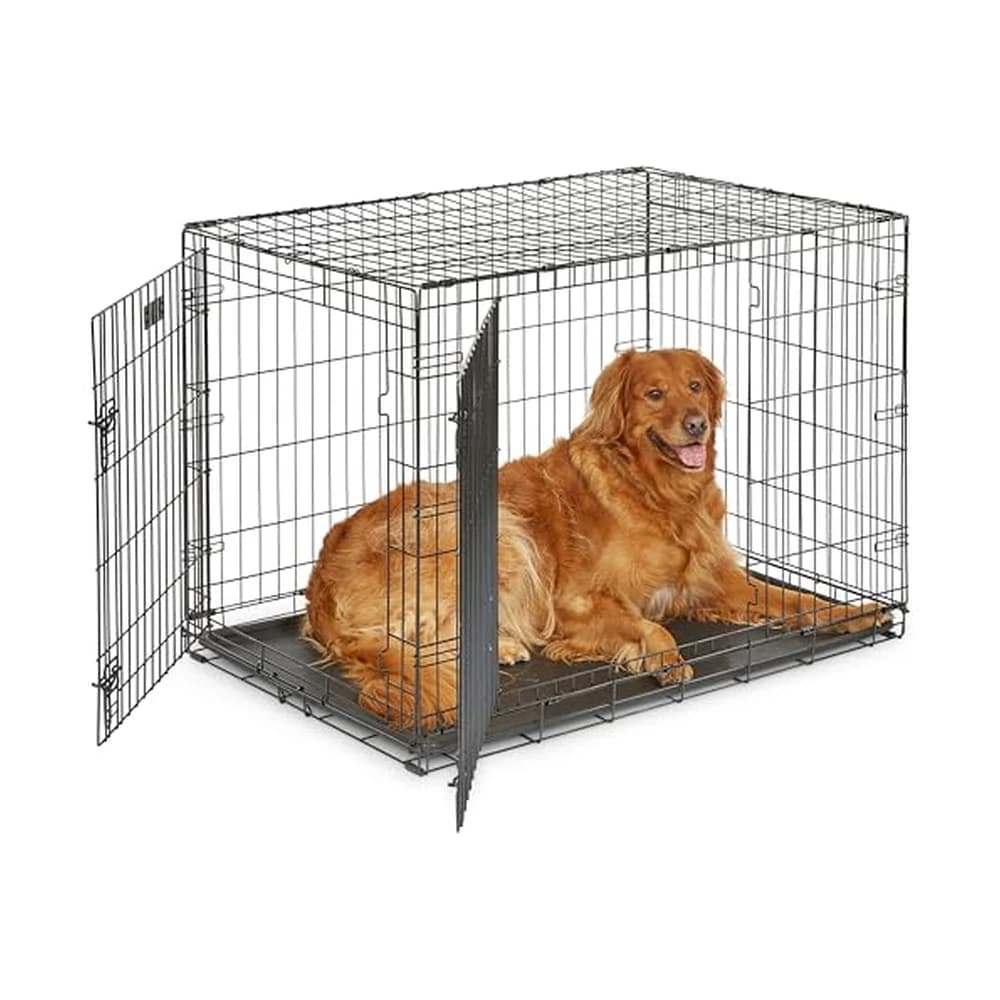
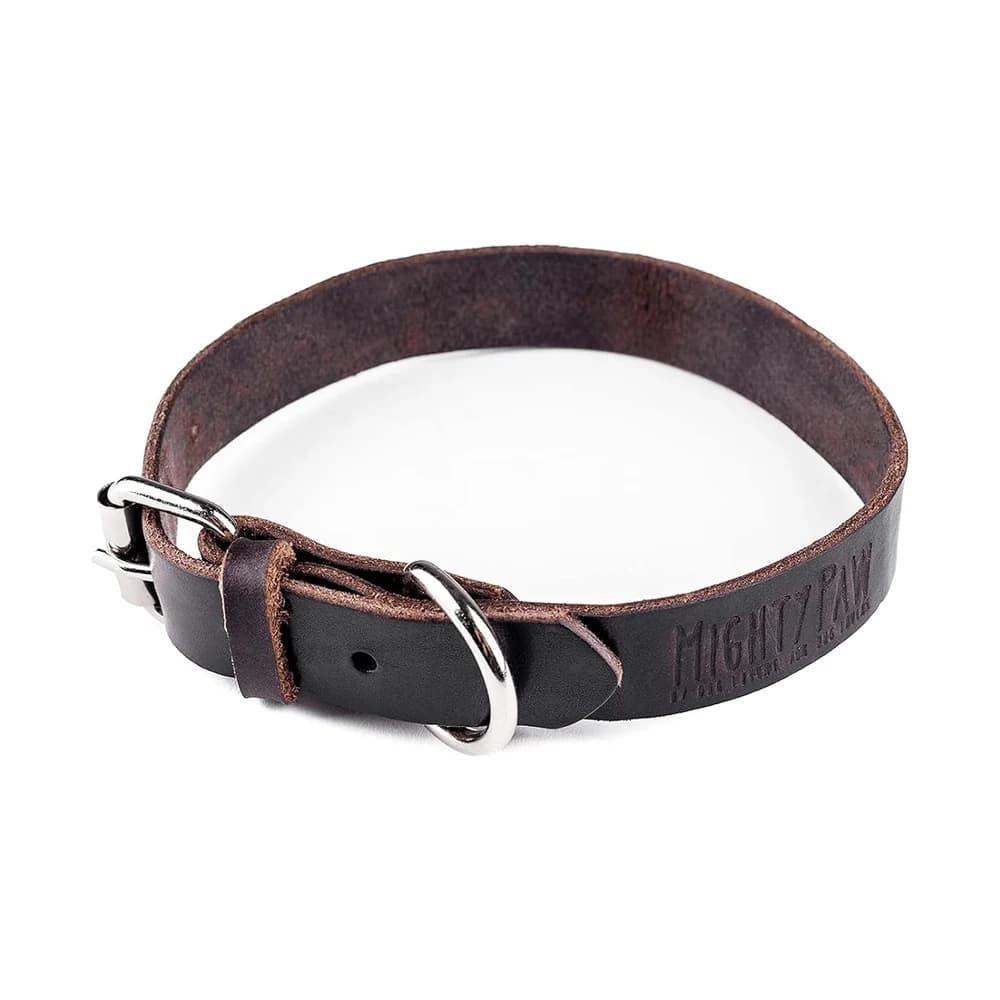
Then buy for the estimate. The crate size tool sizes a crate to the adult dog, and the puppy crate size guide explains why its pick, the MidWest iCrate Double Door, comes with a divider. A first collar should adjust too, like the five-setting Mighty Paw Leather Collar.
What the timeline changes about food
VCA's nutrition pages turn the timeline into a feeding plan:
- Faster is not better. VCA says maximal growth, usually from high-energy food, overfeeding or free-choice feeding, raises the risk of skeletal deformities and obesity, and recommends measured portions adjusted to growth and body condition.
- Large and giant puppies are the sensitive group. VCA counts dogs that reach 70 lb or more as adults as large or giant, and says they need calcium and phosphorus in more tightly controlled amounts. Look for an AAFCO statement for growth "including the growth of large size dogs (70 lb or more as an adult)".
- No add-ons. Puppies need more calcium than adults, but VCA warns that excess calcium can contribute to growth abnormalities, and says to give no vitamin or mineral supplements on top of a complete puppy food without asking your vet.
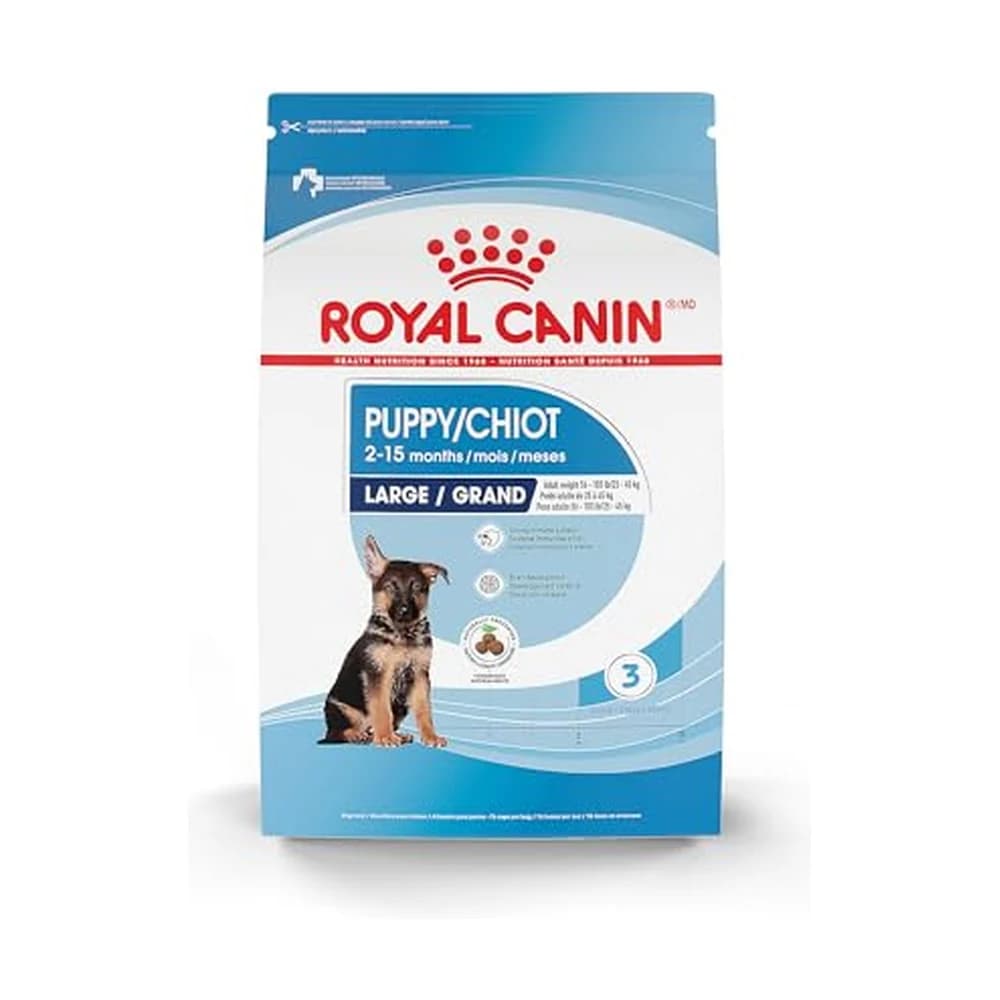
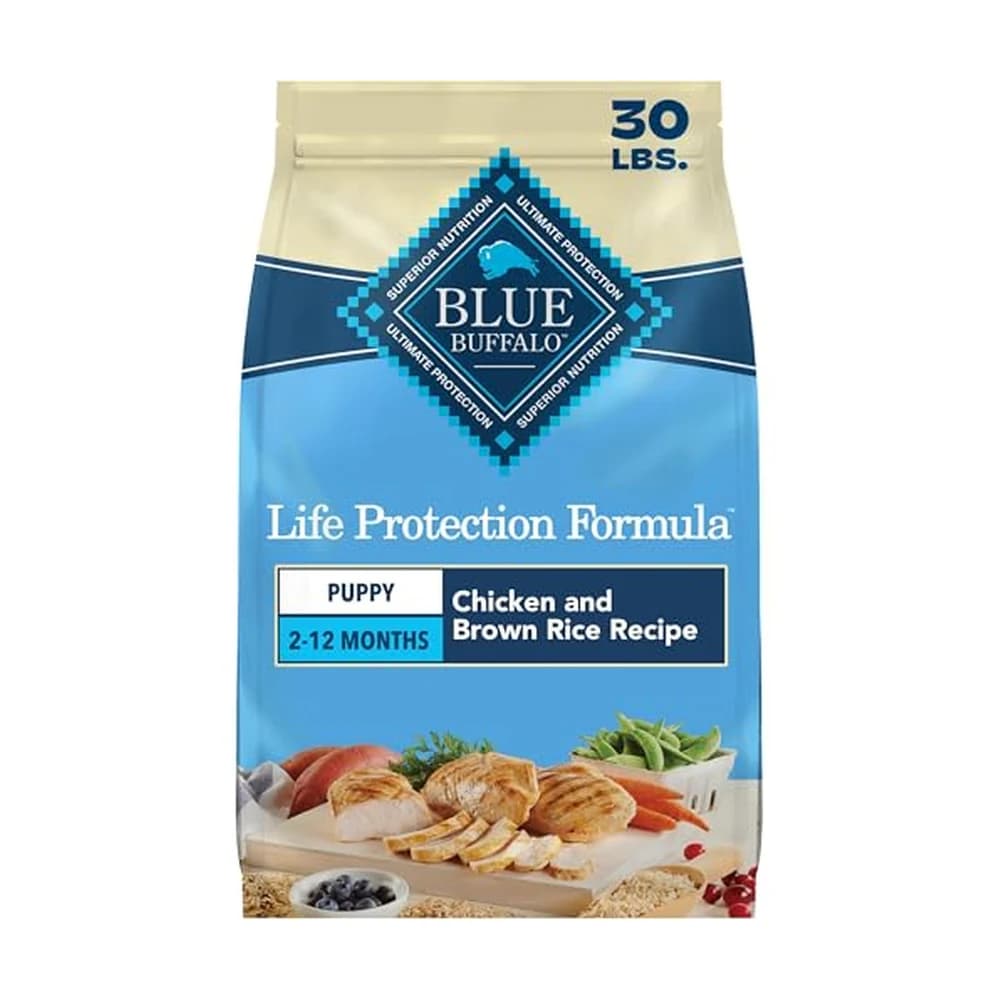
On the puppy food shelf, Royal Canin Large Puppy is our pick for a puppy heading to 56 to 100 pounds, and Blue Buffalo Life Protection Puppy for small and medium puppies. Check any bag's AAFCO statement against your puppy's expected adult size.
When to switch: VCA's large and giant breed guidance keeps large breeds on a growth formula until around 18 months and giant breeds until 24, or until they reach adult weight. AKC's general figure for puppy formulas is around 11 to 14 months. Your vet decides which applies.
Exercise while the growth plates are open
AKC advises regular, moderate exercise for growing puppies, not intense or prolonged activity. Dr. Klein warns that excessive, prolonged activity like jogging can be "extremely detrimental" to growing bones and joints, and says road work or jogging is never recommended for a dog under 14 to 18 months, especially large and giant breeds, until the growth plates have fused.
Rule of thumb: Short walks on softer ground such as grass for now, and no running-partner plans before 14 to 18 months.
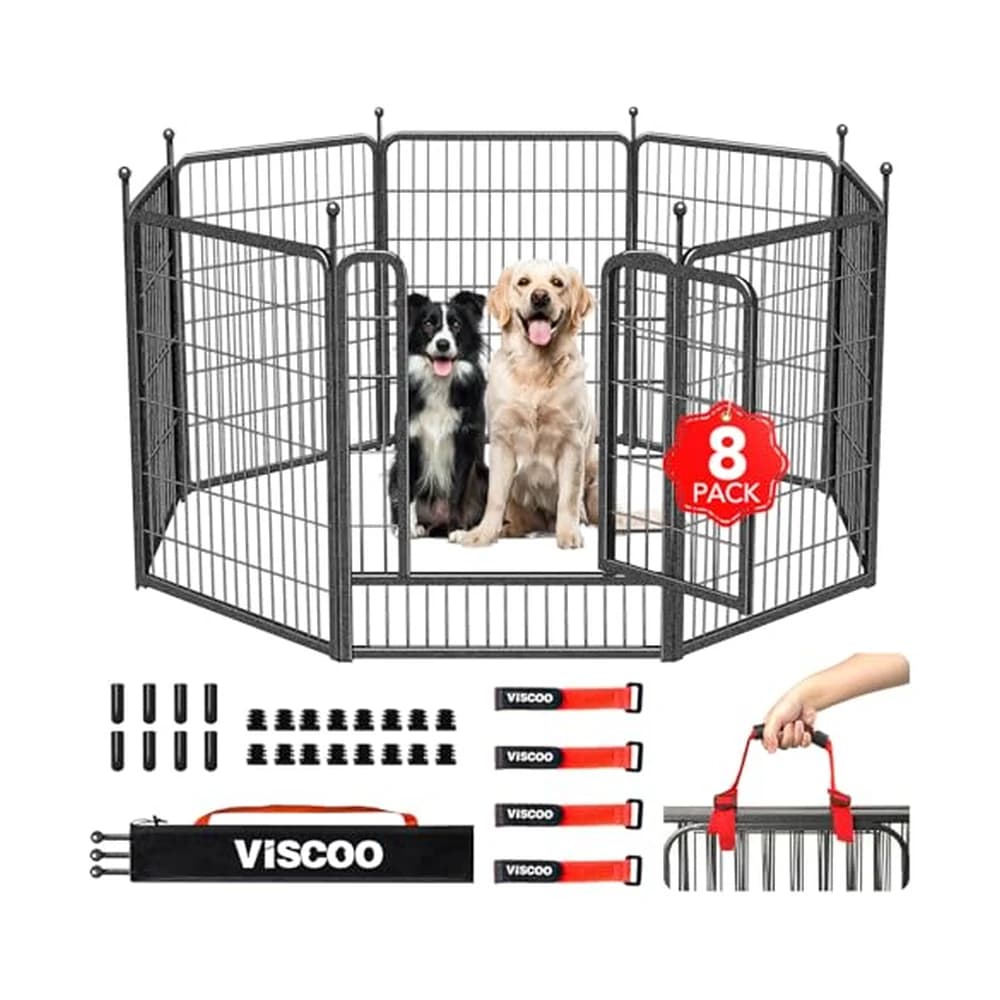
Big dogs are still growing through our adolescent stage as their energy peaks, so supervised play in a tall pen like the VISCOO 40-Inch Playpen fits AKC's moderate-exercise advice better than distance does.
When to take the growth question to your vet
Bring your weight log, and go sooner for:
- Limping, stiffness or reluctance to move, especially in a large or giant puppy. VCA lists hip and elbow dysplasia and osteochondrosis among the developmental orthopedic diseases those breeds are predisposed to.
- A puppy crossing percentile lines on its chart, up or down.
The size timeline tells you roughly when. Your puppy's own curve tells you whether.
Key takeaways
What to remember
- Adult size sets the timeline. AKC's growth chart has a small dog at about 75 percent of adult size at six months and an extra-large dog at about 50 percent.
- Height stops when the growth plates close, but AKC notes young dogs keep adding muscle and body fat afterwards.
- No formula predicts adult weight. Start from the breed's expected weight or healthy parents' weights, then let frequent weigh-ins on a growth chart correct the guess.
- VCA counts dogs that reach 70 lb or more as adults as large or giant and says their calcium and phosphorus need tighter control, so look for an AAFCO growth statement that covers large size dogs.
- AKC's chief veterinarian advises against jogging or road work before 14 to 18 months, especially in large and giant breeds.
Questions people ask
- At what age is a puppy fully grown?
- It depends on adult size. AKC says small breeds typically stop growing by 6 to 8 months and medium breeds reach adult size at around 12 months. VCA puts most large breeds at adult size between 12 and 18 months, and says some giant breeds such as Mastiffs keep growing until about two years.
- Do puppies keep gaining weight after they stop getting taller?
- Yes. AKC notes that after the growth plates close and skeletal growth is complete, young dogs continue to develop muscle and body fat. Regular weigh-ins and body condition checks show whether that gain is healthy.
- How can I tell how big my puppy will get?
- Start from the breed's expected adult weight or the parents' weights, if the parents are in ideal body condition, and track your puppy on a growth chart for that size. Weighing every one to two weeks shows which curve the puppy is following. For mixed and giant breeds the estimate is rougher, so ask your vet.
- When should a large-breed puppy switch to adult food?
- Later than a small dog. VCA's large and giant breed guidance says large breeds should stay on an appropriate growth formula until around 18 months and giant breeds until 24 months, or until they reach adult weight. Confirm the timing with your vet.
- Can I take my puppy jogging?
- Not yet. AKC's chief veterinarian says road work or jogging is never recommended for a dog under 14 to 18 months, especially large and giant breeds, until the growth plates have fused. Short walks on softer surfaces such as grass are the safer choice while a puppy is growing.
Gear
Gear for this stage
The products this piece assumes, in the order we would get them. Prices move; check before you buy.
$109.99 4.7 out of 5 stars · 8,900
A puppy whose adult weight will be 56 to 100 lb — controlled calcium and phosphorus through…
$65.99 4.7 out of 5 stars · 18,081
A small or medium puppy from two to twelve months — real chicken first, with DHA and ARA in…
$100.99 4.7 out of 5 stars · 80,183
The one crate you buy at eight weeks and still use at eight years — the included divider…
$14.99 4.6 out of 5 stars · 3,486
A soft first collar that grows a little — five adjustment settings, genuine leather that…
$94.99 4.3 out of 5 stars · 792
The adolescent who has learned to clear a 30-inch pen — 40 inches high, with a door panel and…
Sources
- American Kennel Club: Puppy Growth Chart: When Does My Puppy Finish Growing? — The percentage-of-adult-size chart by adult weight class, Dr. Jerry Klein on growth plates, when small, medium and giant breeds stop growing, the rib-knob check for mixed breeds, continued muscle and fat gain after skeletal growth, puppy formulas fed to around 11 to 14 months, large-breed calcium sensitivity, and no jogging or road work before 14 to 18 months.
- VCA Animal Hospitals: Puppy Growth and Maturity — Adult size at 6 to 12 months for small breeds and 12 to 18 months for most large breeds, Mastiffs growing to about 2 years, and the end of puppyhood at 6 to 8 months for really small dogs, around a year for medium dogs and 18 to 24 months for large and giant dogs.
- VCA Animal Hospitals: Feeding Growing Puppies — Adulthood at 10 to 12 months for small and medium breeds and 18 to 24 months for large and giant breeds, the risks of a maximal growth rate, portion feeding, weigh-ins and body condition checks, excess calcium and growth abnormalities, the AAFCO large-breed puppy statement, and no supplements without a vet.
- VCA Animal Hospitals: Nutritional Considerations for Large and Giant Breed Dogs — Large or giant defined as 70 lb or more as an adult, tighter calcium and phosphorus control, the AAFCO growth statement wording for large size dogs, growth formula until around 18 months for large and 24 months for giant breeds, giant-breed growth curves from the vet, and the developmental orthopedic diseases these breeds are predisposed to.
- AAHA 2019 Canine Life Stage Guidelines: Canine Life Stage Definitions — The puppy stage running from birth to the cessation of rapid growth at about 6 to 9 months, varying with breed and size.
- WALTHAM Petcare Science Institute: Puppy Growth Charts — The 14 charts across seven size groups, validation from 12 weeks of age, estimating adult weight from breed or parents, and switching charts when the first estimate was wrong.
- Royal Canin Academy: Puppy growth charts — Estimating adult weight from parents in ideal body condition or the breed standard, weighing at least every two weeks and ideally weekly at the same time of day, best-guess placement for mixed breeds, and percentile crossing in dogs that became obese.
- Salt et al. (2017), Growth standard charts for monitoring bodyweight in dogs of different sizes, PLOS ONE — That the growth standards could not fit a single curve to giant breeds because Great Danes and Mastiffs grew differently.
We research and analyse — specs, manufacturer documentation and large-scale owner feedback. We do not test products on dogs, and we are not your vet.
Next step
Size the crate to the adult, not the puppy
Once you have an adult-weight estimate, the tool turns it into a crate size with the divider set for now, so you buy once.