We research gear rather than testing it, and some links below are Amazon affiliate links — if you buy through one we may earn a commission, at no extra cost to you. It does not change what we recommend. Full disclosure.
In this article(6 sections)
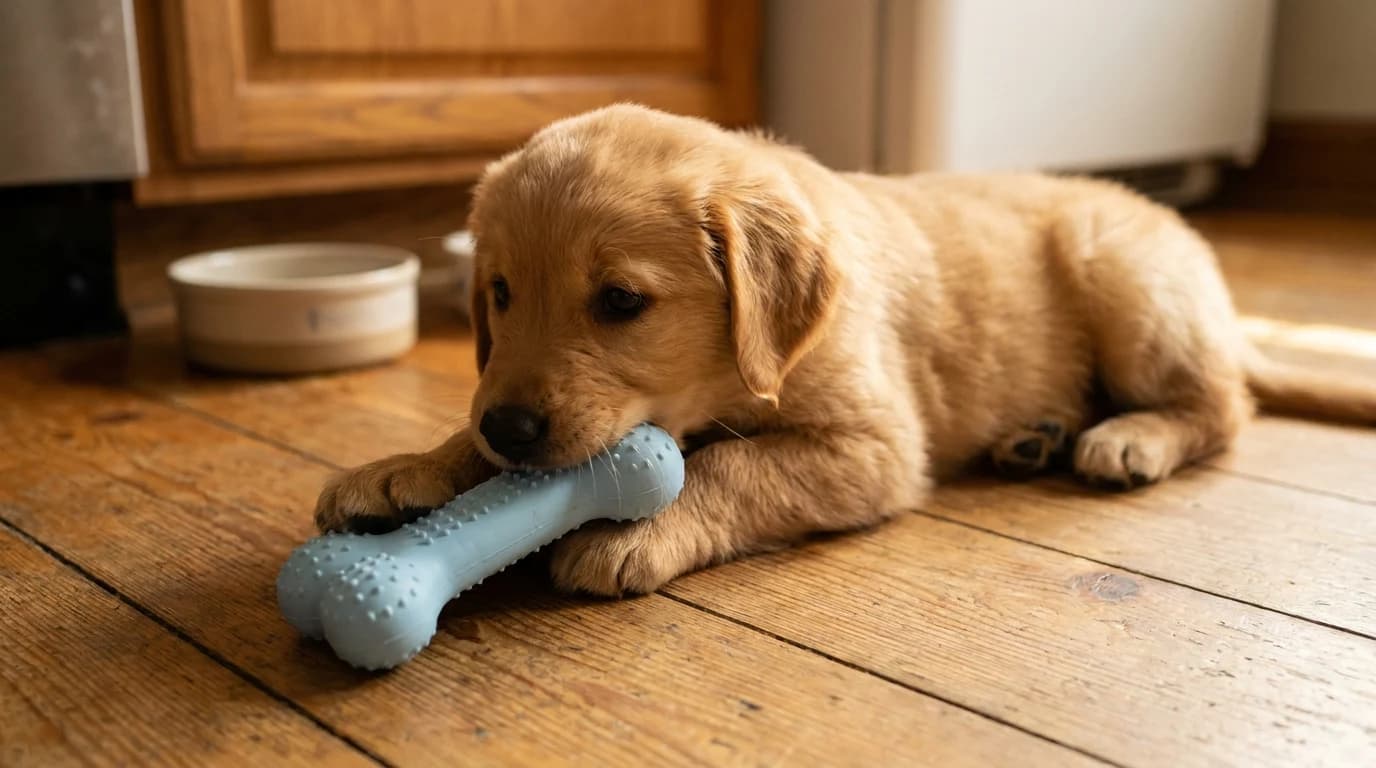
Most puppies stop teething by about six to seven months, when the last of their 42 adult teeth is in. The swap from baby teeth starts at roughly three to four months, so the hard stretch is about three months long. The chewing outlasts the teeth: VCA Animal Hospitals says excessive chewing tends to ease at around 18 months. Teething belongs to the puppy stage; the timeline below says what to do at each point.
The numbers: 28 baby teeth, 42 adult teeth, and no baby molars. Sources: the Merck Veterinary Manual and VCA.
The teething timeline, and your job at each age
| Age | In the mouth | What you'll notice | What to do |
|---|---|---|---|
| 3 to 6 weeks | Baby incisors, canines and premolars erupt | Needle-sharp teeth, usually while still with the litter | Nothing yet; this happens before most puppies come home |
| 8 to 12 weeks | The full set of 28 baby teeth | Nipping hands, sleeves and ankles | Trade hands for a soft toy every time; start gently handling the mouth |
| About 3 to 4 months | Baby teeth loosen; adult incisors start at about 4 months | Tiny hollow tooth shells, often swallowed; faint pink on toys | Offer chews that bend; begin a weekly look inside the mouth |
| 4 to 5 months | Adult incisors, first premolars and first molars | Drooling, a tender mouth, meals eaten less keenly | Rotate a few toys; puppy-proof what is within reach |
| 5 to 6 months | Adult canines, the rest of the premolars, second molars | Peak chewing; check for two canines side by side | A doubled tooth means a vet visit now, not at the next jab |
| 6 to 7 months | Last molars; all 42 adult teeth present | The mouth settles; chewing carries on | Keep the weekly check until 7 to 8 months |
| 7 to 18 months | Teeth finished | Chewing driven by energy and boredom | Move to tougher toys that still pass the bend test |
The tooth ages come from the Merck Veterinary Manual's eruption table, which marks them as averages subject to considerable variation. The symptoms and the weekly check come from VCA's pages on teething and persistent baby teeth.
Which teeth come in when
Merck's table by tooth type shows why the front of the mouth settles first:
| Tooth type | Baby tooth erupts | Adult tooth erupts |
|---|---|---|
| Incisors (front) | 3 to 5 weeks | 4 to 5 months |
| Canines (fangs) | 3 to 4 weeks | 5 to 6 months |
| Premolars | 4 to 6 weeks | 4 to 6 months |
| Molars | None | 4 to 7 months |
Why sources differ by a few weeks: VCA's teething page starts the swap at around 12 weeks and finishes it by six months; its persistent-teeth page says three and a half to four months, done by six to seven; Merck says four to five months, done by seven. Plan for a start between 12 and 16 weeks and a finish by seven months.
The weekly check: two teeth in one spot
The teething problem an owner can catch is a persistent, or retained, baby tooth. VCA defines it as a baby tooth still present when the adult tooth erupts, so the adult tooth is forced to come in at the wrong angle.
- Where to look: the upper canines most often, then the lower canines, then the incisors.
- Who gets them: they are more common in small breeds and in short-nosed breeds such as bulldogs, pugs, Boston terriers and boxers.
- Why it matters: food and plaque pack into the crowded gap, which leads to gum disease. A retained lower baby canine can push the adult canine inward until it presses into the roof of the mouth.
- How often: VCA advises checking your puppy's mouth every week until about seven to eight months.
See your vet: if you see two teeth where there should be one, a lower canine pointing at the roof of the mouth, bleeding beyond a faint pink stain on a toy, or a puppy who stops eating. VCA calls a little blood while teeth are falling out normal, and a tender mouth can dull the appetite, but refusing food is a reason to call.
Timing matters. VCA's persistent-teeth page says these teeth usually need prompt extraction under general anaesthesia and, in most cases, should not wait for the spay or neuter appointment, because early removal usually lets the adult teeth move into place. Left too long, the fix can mean orthodontics. (VCA's general teething page says removal is often done at the spay or neuter visit; follow the more specific page.)
 A weekly look at the canines is the whole check: one tooth per spot.
What a teething puppy should chew
The simplest rule comes from Graham Thatcher, then a veterinary dentist at the University of Wisconsin School of Veterinary Medicine: if you can bend or flex it, it is less likely to fracture a tooth, and if it is too hard for you to chew, your dog should not chew it either. VCA adds that most veterinary dentists advise against anything hard for puppies and adult dogs alike.
Give:
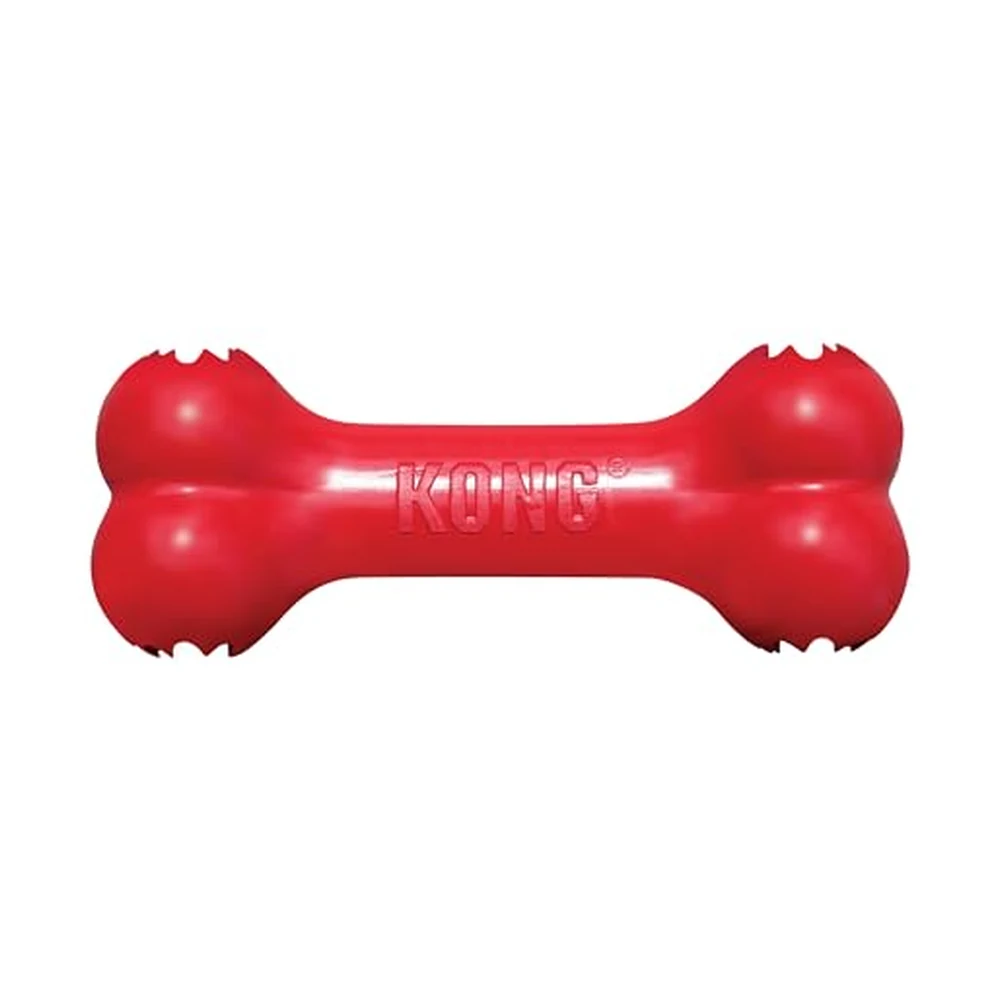
- Rubber you can bend with your hands, like the KONG Goodie Bone, a medium size with a stuffable pocket at each end.
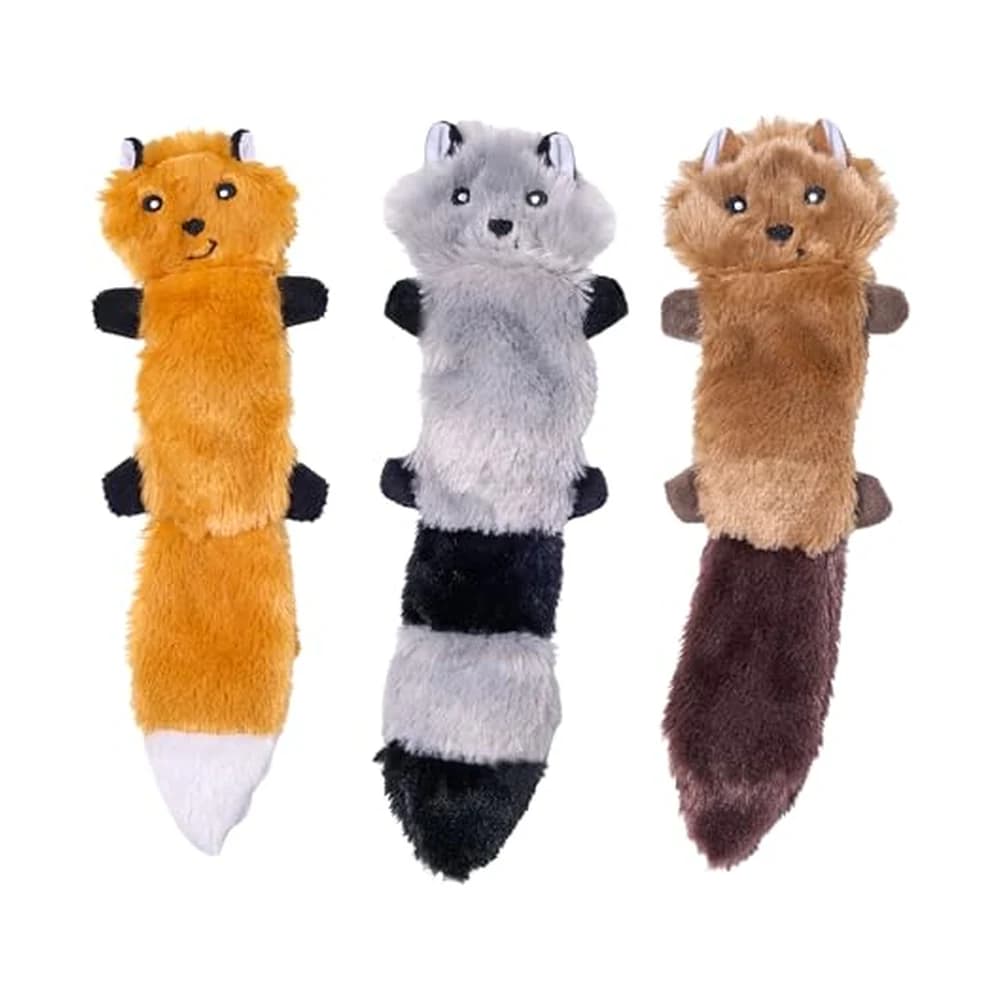
- Stuffing-free plush, like the ZippyPaws Skinny Peltz 3-Pack, light enough for a small puppy to carry.
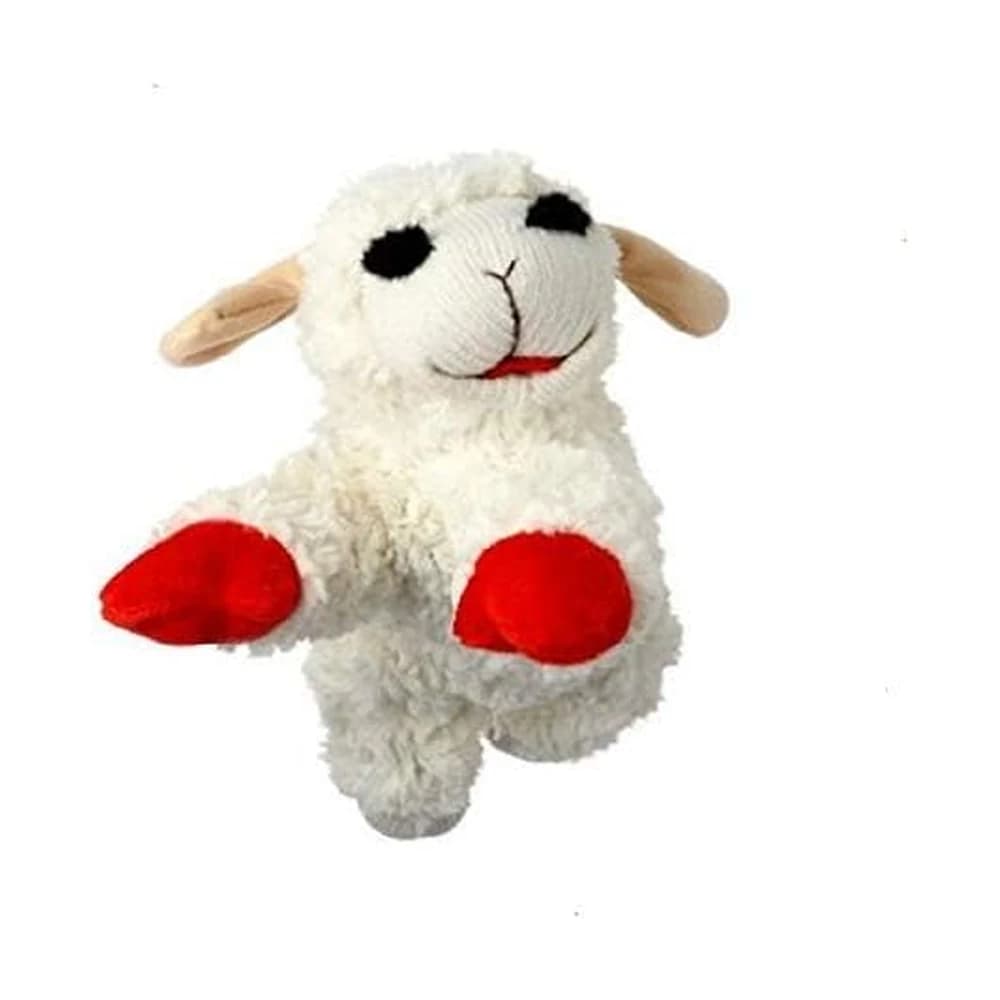
- A soft comfort toy for the crate, like the Multipet Lamb Chop, which is rated for gentle chewers only.
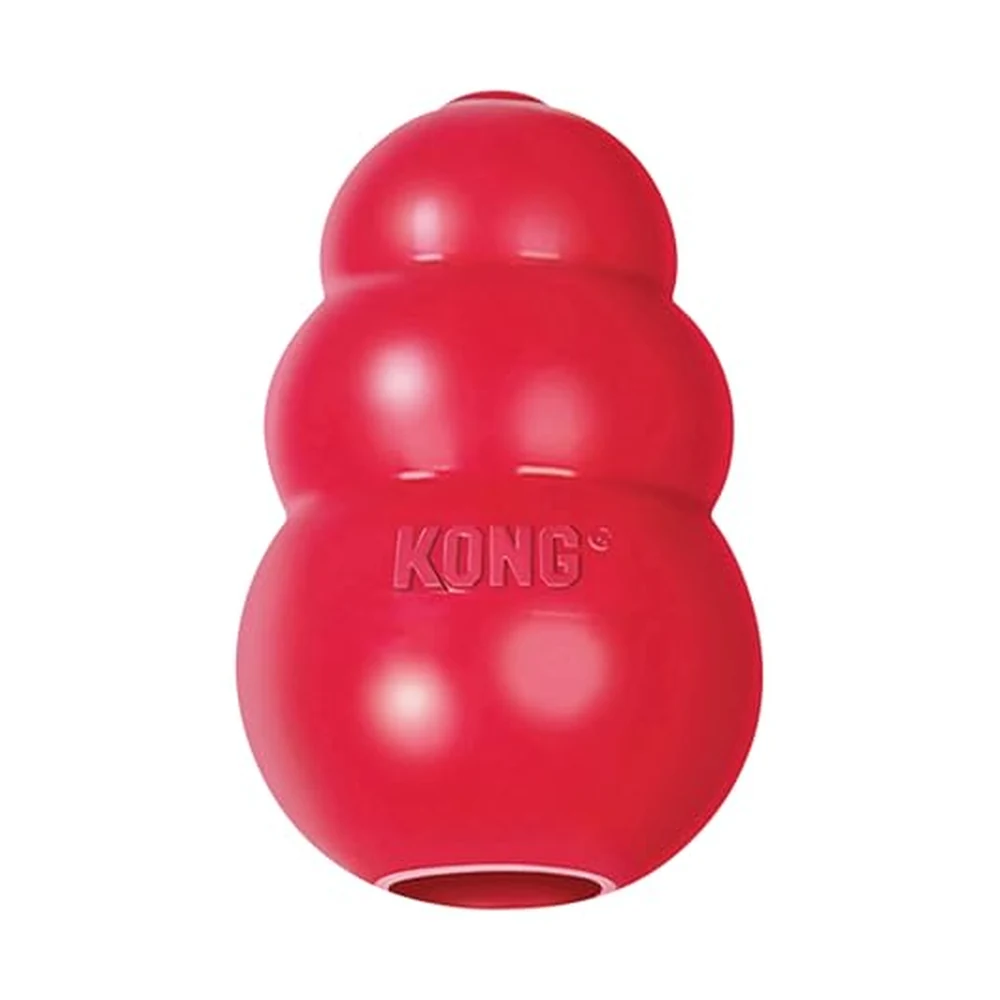
- For a big-breed puppy, the KONG Classic Stuffable; the listing we link is the large size, so size down for a smaller dog.
Skip:
- Bones, antlers and bully sticks, which the Wisconsin dentist says commonly fracture teeth.
- Nylon chews, cow hooves and ice cubes, all on VCA's list of things that can damage teeth.
- Anything that will not bend. If you chill a rubber toy, flex it before you hand it over; frozen solid fails the test.
VCA's other rule covers every toy here: supervise, because no toy is completely safe. The teething and chew toys shelf has the full set.
Teething or ordinary mouthing?
Usually both. VCA describes chewing as how puppies explore, strongest in mouthy breeds such as retrievers, and says it seems to ease teething discomfort. Signs that point to the teeth: drool, puppy breath, pink-tinged toys and a mouth that seems sore at meals.
The response is the same either way:
- Don't reward the bite. VCA suggests a high-pitched yelp, pulling your hand away and going to play elsewhere.
- Stop rough hand games, including with children. They teach that hands are toys.
- Keep a few toys out and rotate them so the legal options stay interesting.
- Feed from a puzzle toy some days instead of a bowl.
- Clear the floor of shoes, clothes and children's toys, room by room, with the puppy-proofing guide.
VCA admits there is no consensus on the best method, so ask your vet if one isn't working. Mouthing overlaps the socialization window; chewing after seven months is covered in adolescent regression and the heavy chewer toys guide.
Start the toothbrush while the teeth change
VCA recommends getting a puppy used to something in its mouth besides food, and warns that human toothpaste can make dogs sick. The Wisconsin dentist's sequence suits a sore mouth:
- Short sessions of gum massage with a finger first, then a soft-bristled brush.
- A pet toothpaste without added fluoride, since pets swallow some of it.
- Keep it painless and end with a reward.
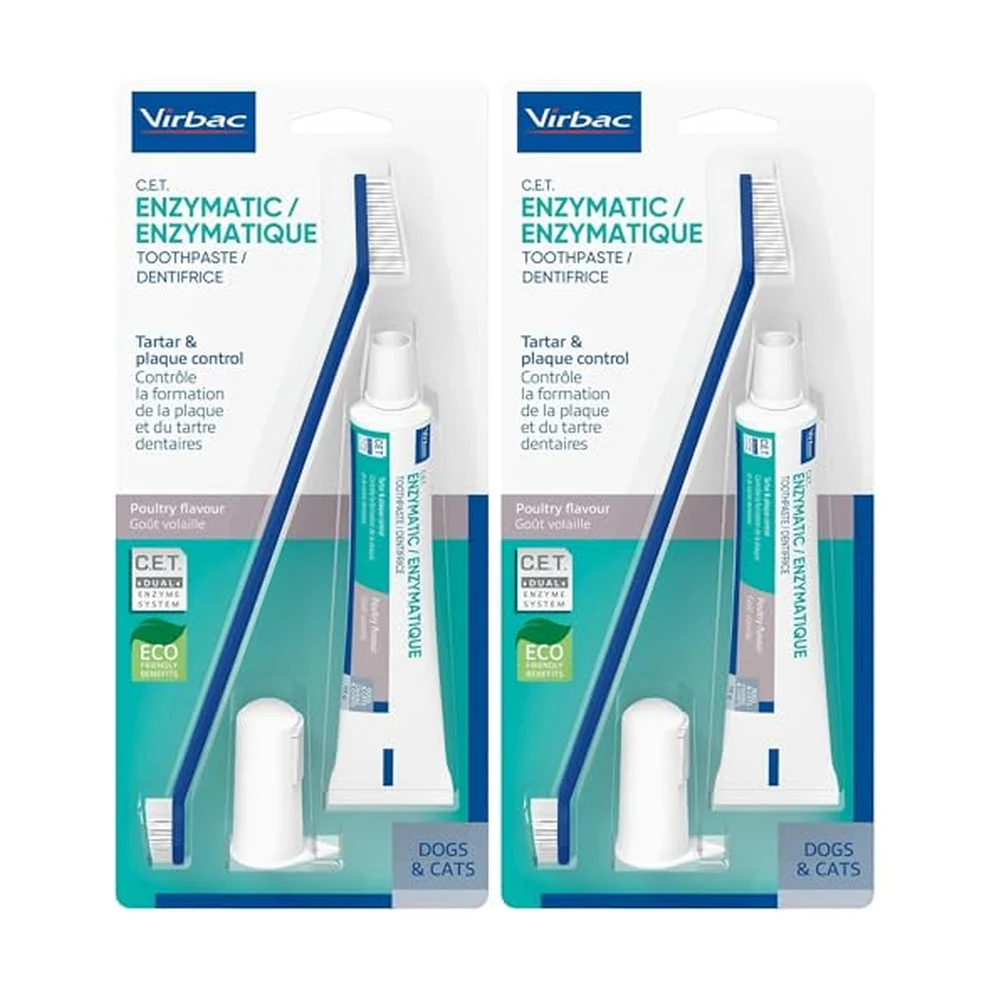
A kit with a finger brush, such as the Virbac C.E.T. Oral Hygiene Kit, covers the first step. Teething runs alongside the puppy sleep schedule and crate training; the dog age calculator confirms your puppy's stage.
Key takeaways
What to remember
- Puppies grow 28 baby teeth and 42 adult teeth, per the Merck Veterinary Manual, and have no baby molars.
- The swap runs from roughly 12 to 16 weeks until six to seven months; Merck marks its eruption ages as averages with considerable variation.
- Check the mouth weekly until seven to eight months. Two teeth in one spot, most often the upper canines, is a persistent baby tooth and needs a vet promptly.
- A UW-Madison veterinary dentist's rule: if you can bend or flex a chew it is less likely to fracture a tooth. VCA lists nylon chews, hooves, ice cubes and bones as things to avoid.
- Faint pink on a toy is normal while teeth fall out, according to VCA. Heavier bleeding or a puppy who stops eating is a reason to call your vet.
Questions people ask
- When do puppies stop teething?
- Usually by six to seven months. The Merck Veterinary Manual says all permanent teeth are present by 7 months, and VCA says most puppies have all their adult teeth by 6 to 7 months. Individual puppies vary by a few weeks either way.
- How long does puppy teething last?
- The swap from baby to adult teeth takes about three months, starting at roughly 12 to 16 weeks and finishing by six to seven months. Chewing carries on after that; VCA says excessive chewing tends to ease at around 18 months.
- Is it normal for a teething puppy's gums to bleed?
- A little, yes. VCA says some bleeding while baby teeth fall out is not unusual and is usually only visible as mild red staining on a chew toy. More bleeding than that, or a puppy who stops eating, is a reason to see your vet.
- What if my puppy's baby tooth has not fallen out?
- If the adult tooth is already coming in beside it, that is a persistent baby tooth. VCA advises booking a vet visit as soon as possible, because these teeth usually need prompt extraction so the adult tooth can move into its proper position, and in most cases it is not worth waiting for the spay or neuter appointment.
- Can I give a teething puppy ice cubes or frozen chews?
- VCA lists ice cubes among the things that can damage teeth, alongside nylon chews, hooves and bones. A UW-Madison veterinary dentist suggests only giving chews you can bend or flex, so a chilled rubber toy that still bends is a better choice than anything frozen solid.
Gear
Gear for this stage
The products this piece assumes, in the order we would get them. Prices move; check before you buy.
$11.96 4.5 out of 5 stars · 17,607
A stuffable chew that survives the teething stage — freeze it filled and it occupies a puppy…
$19 4.5 out of 5 stars · 65,796
The shake-and-carry instinct — no stuffing to pull out, three toys in a pack, and light…
$13.99 4.4 out of 5 stars · 2,964
The comfort toy — the soft thing a new puppy sleeps against in the first anxious weeks away…
$13.96 4.6 out of 5 stars · 91,774
The stuffed-and-frozen standby — the toy that covers crate time, alone time and the first…
$27.52 4.6 out of 5 stars · 5,974
Starting properly — a dual-enzyme poultry toothpaste with both a fingerbrush and a…
Sources
- Merck Veterinary Manual (Pet Owner Version): Dental Development of Dogs — 28 deciduous and 42 permanent teeth, deciduous teeth erupting at 3 to 5 weeks, permanent teeth appearing at around 4 to 5 months and all present by 7 months.
- Merck Veterinary Manual: Table, Eruption of the Teeth — Eruption ages for each deciduous and permanent tooth in the dog, and the note that they are averages subject to considerable variation.
- VCA Animal Hospitals: Teeth, Teething and Chewing in Puppies — No baby molars, baby teeth in by about six weeks and falling out from around 12 weeks, normal minor bleeding, mouthy breeds, chew items to avoid, supervision, the yelp-and-withdraw response to biting, toy rotation, chewing easing at around 18 months, and early toothbrush training.
- VCA Animal Hospitals: Persistent Deciduous Teeth (Baby Teeth) in Dogs — Teething from 3.5 to 4 months to 6 to 7 months, drooling and reduced appetite, avoiding hard toys, nylon, hooves, ice cubes and bones, persistent-tooth definition, sites, breed predisposition and problems, prompt extraction rather than waiting for spay or neuter, and weekly mouth checks until 7 to 8 months.
- University of Wisconsin School of Veterinary Medicine: Protect Your Pet's Teeth, Top Tips from a Veterinary Dentist — No bones, antlers or bully sticks, the bend-or-flex rule, and the gum massage to soft brush sequence with a pet toothpaste without added fluoride.
We research and analyse — specs, manufacturer documentation and large-scale owner feedback. We do not test products on dogs, and we are not your vet.
Next step
The teething and chew toys shelf
Every pick on the shelf is soft enough to bend, which is the one test that matters while baby teeth are falling out.
Between roughly three and seven months a puppy loses 28 baby teeth and grows 42 adult ones. Chewing is not naughtiness — it is the stage.