Tools
Puppy Weight Calculator: How Big Will My Puppy Get?
Age, weight and expected size in; a projected adult weight range out, read off published growth curves rather than a rule of thumb.
Project the adult weight
Expected adult size
Medium: about 22 to 55 lb full-grown, e.g. Beagle, Boston Terrier, Cocker Spaniel. Not sure? Use the breed standard or the parents' weights if you know them, then let the result below tell you if the guess was off.
Enter an age between 8 and 78 weeks (about 2 to 18 months) and today's weight. The projected adult range appears here, with the growth curves it was read from.
Nothing you enter leaves your browser. This is an estimate from population averages, not a prediction for your puppy: individual dogs vary more than breed curves do, and males and females grow differently. A puppy that is steadily gaining and stays at an ideal body condition is growing fine, whatever the projection says.
How the projection works
In 2004 the WALTHAM Centre for Pet Nutrition published the growth of 173 puppies from twelve breeds, weighed every week to about a year (toy to medium) or eighteen months (large and giant), and fitted each breed with one logistic growth curve. For each curve the Journal of Nutrition paper gives the adult weight, the weeks to reach half of it and the weeks to reach 99%. From those, the share of adult weight at any age is a single line of arithmetic, and today's weight divided by that share is the projection.
We place each breed in a size class by its adult weight and read your puppy against every curve in its class plus the nearest breed either side, so the answer is a range rather than one confident number. The neighbour rule is ours: two classes have a single breed each in the paper, and a range from one curve would be a point pretending to be a range.
| Breed | Our size class | Adult weight | Half grown | 99% grown |
|---|---|---|---|---|
| English Mastiff | giant | 66.9 kg (147 lb) | 22.9 weeks | 65.2 weeks |
| St. Bernard | giant | 65.2 kg (144 lb) | 21.9 weeks | 56.7 weeks |
| Irish Wolfhound | giant | 52.4 kg (116 lb) | 19.1 weeks | 49.1 weeks |
| Great Dane | giant | 51.1 kg (113 lb) | 18.1 weeks | 52.1 weeks |
| Newfoundland | giant | 43.3 kg (95 lb) | 18.5 weeks | 46.1 weeks |
| Labrador Retriever | large | 28.1 kg (62 lb) | 18.6 weeks | 52.1 weeks |
| Beagle | medium | 17.4 kg (38 lb) | 14.8 weeks | 41.9 weeks |
| English Springer Spaniel | medium | 14.8 kg (33 lb) | 14.3 weeks | 39.4 weeks |
| Cocker Spaniel | medium | 10.2 kg (22 lb) | 16.6 weeks | 46.6 weeks |
| Miniature Schnauzer | small | 7 kg (15.4 lb) | 14.1 weeks | 41.3 weeks |
| Cairn Terrier | small | 6.3 kg (13.9 lb) | 15.5 weeks | 42.9 weeks |
| Papillon | toy | 2.2 kg (4.9 lb) | 11.1 weeks | 41.7 weeks |
Hawthorne et al., J Nutr 2004, Table 1. The paper files the Cocker Spaniel (10.2 kg) under small; by our size bands it is medium, and that is where the calculator uses it. The groups were small — one to twenty-one dogs per sex per breed — and the authors note that similar-sized breeds still grew differently.
The “double the 16-week weight” rule, checked
It is a widely repeated rule of thumb, and it is a folk rule: we found no published study behind it. The published curves say what the multiplier at 16 weeks really is — close to two for small and medium dogs, well under it for a toy, and well over it for large and giant breeds, whose puppies are less than half grown at that age.
| Breed curve | Size | Multiply the 16-week weight by |
|---|---|---|
| Papillon | toy | × 1.48 |
| Cairn Terrier | small | × 1.92 |
| Miniature Schnauzer | small | × 1.73 |
| Cocker Spaniel | medium | × 2.1 |
| English Springer Spaniel | medium | × 1.73 |
| Beagle | medium | × 1.82 |
| Labrador Retriever | large | × 2.43 |
| Newfoundland | giant | × 2.52 |
| Great Dane | giant | × 2.33 |
| Irish Wolfhound | giant | × 2.61 |
| St. Bernard | giant | × 3.18 |
| English Mastiff | giant | × 3.12 |
Printable puppy growth chart by size
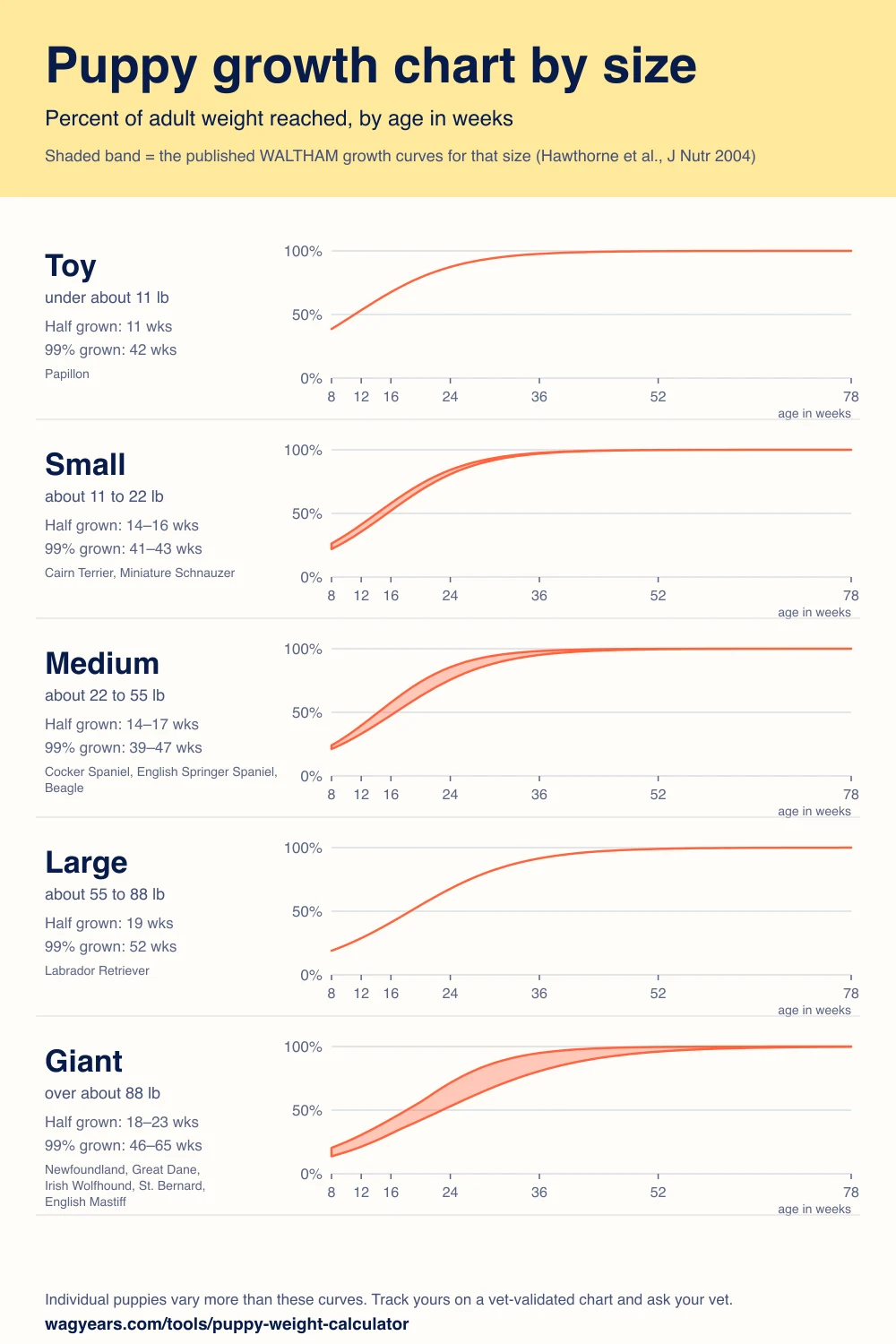
The share of adult weight a puppy has usually reached at each age, computed from the same WALTHAM curves the calculator uses. Where a size has several curves, the cell shows the spread between them. Write your puppy's weights in the last column, and bring the sheet to the vet.
| Age | Toyunder about 11 lb | Smallabout 11 to 22 lb | Mediumabout 22 to 55 lb | Largeabout 55 to 88 lb | Giantover about 88 lb | Your puppy |
|---|---|---|---|---|---|---|
| 8 weeks | 39% | 22–26% | 21–24% | 19% | 14–20% | ______ |
| 10 weeks | 46% | 28–33% | 27–31% | 24% | 17–25% | ______ |
| 12 weeks | 53% | 36–41% | 33–40% | 29% | 21–31% | ______ |
| 14 weeks | 61% | 44–50% | 40–49% | 35% | 26–37% | ______ |
| 16 weeks | 68% | 52–58% | 48–58% | 41% | 31–43% | ______ |
| 20 weeks | 79% | 68–73% | 63–74% | 55% | 42–56% | ______ |
| 24 weeks | 87% | 81–84% | 76–86% | 68% | 53–71% | ______ |
| 28 weeks | 93% | 89–91% | 85–92% | 78% | 64–83% | ______ |
| 32 weeks | 96% | 94–95% | 91–96% | 86% | 73–91% | ______ |
| 36 weeks | 98% | 97–98% | 95–98% | 92% | 81–95% | ______ |
| 40 weeks | 99%+ | 98–99% | 97–99% | 95% | 87–97% | ______ |
| 44 weeks | 99%+ | 99%+ | 99%+ | 97% | 91–99% | ______ |
| 48 weeks | 99%+ | 99%+ | 99%+ | 98% | 94–99% | ______ |
| 52 weeks | 99%+ | 99%+ | 99%+ | 99%+ | 96–100% | ______ |
| 60 weeks | 99%+ | 99%+ | 99%+ | 99%+ | 98–100% | ______ |
| 70 weeks | 99%+ | 99%+ | 99%+ | 99%+ | 99%+ | ______ |
| 78 weeks | 99%+ | 99%+ | 99%+ | 99%+ | 99%+ | ______ |
Source: Hawthorne et al., “Body-weight changes during growth in puppies of different breeds,” J Nutr 2004, Table 1 — curves: toy: Papillon; small: Cairn Terrier, Miniature Schnauzer; medium: Cocker Spaniel, English Springer Spaniel, Beagle; large: Labrador Retriever; giant: Newfoundland, Great Dane, Irish Wolfhound, St. Bernard, English Mastiff. Half grown by toy 11 weeks, small 14–16 weeks, medium 14–17 weeks, large 19 weeks, giant 18–23 weeks. Population averages; an individual puppy can sit well above or below them. wagyears.com
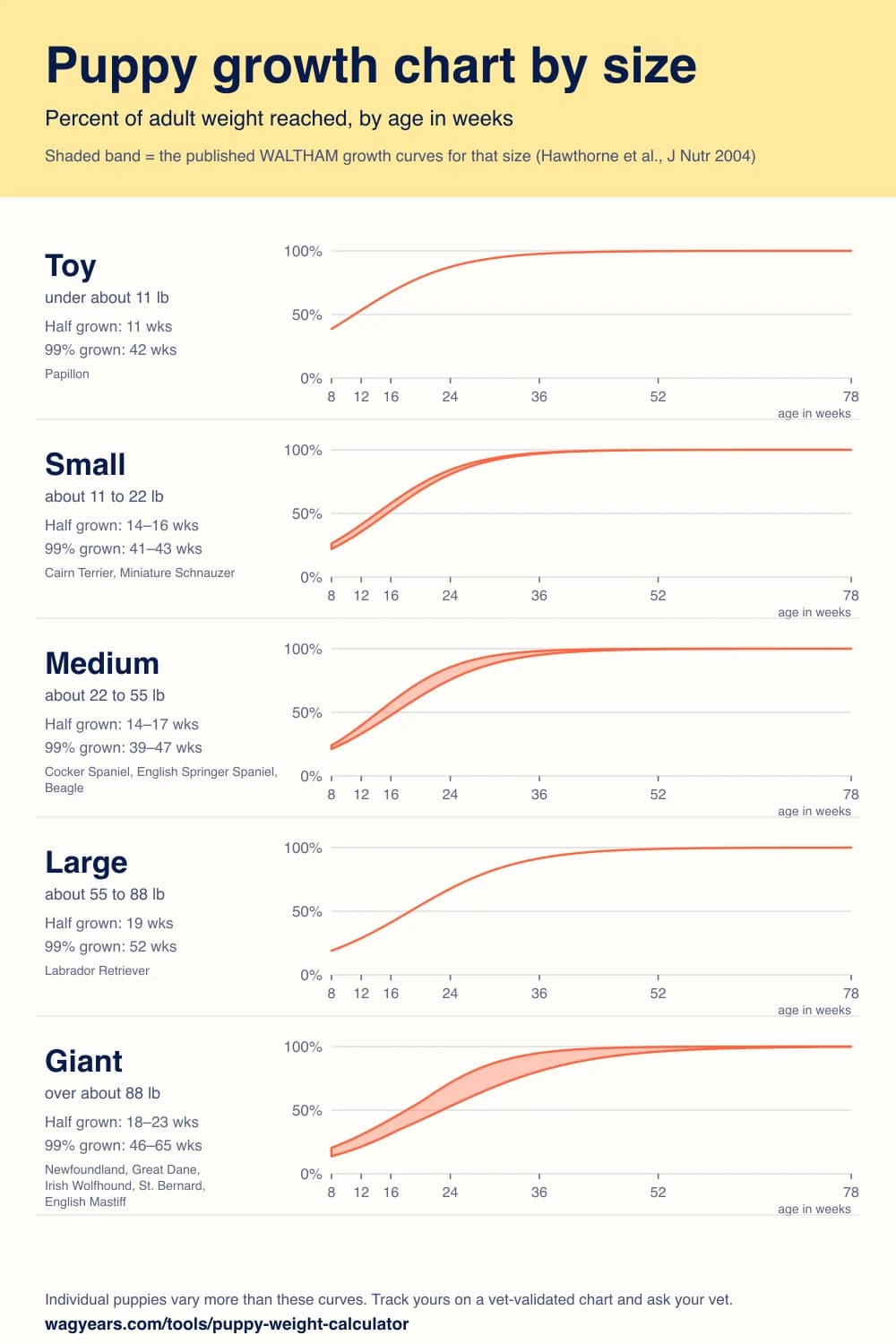
The same chart as an image — download it to save or pin.
Growth plates, adult food, and where this tool stops
Weight is one finish line; height is another, and it ends when the growth plates close. The puppy growth guide covers both by size, and when to move to adult food. For how much to feed along the way, the puppy feeding calculator works from the calories printed on your bag, and the crate size calculator sizes a crate to the adult dog. Everything in the puppy stage builds on these numbers.
We are not veterinarians. A puppy that stops gaining, loses weight, or crosses well away from its curve needs a vet, not a recalculation. Giant breeds are the hardest to project: the 2017 WALTHAM growth-standard study could not fit a single curve to dogs over 40 kg because Great Danes and Mastiffs grew too differently, so ask your vet for a breed-appropriate chart.
Questions people ask next
- How can I tell how big my puppy will get?
- Divide today's weight by the share of adult weight a puppy of that size has usually reached at that age. The WALTHAM growth study published that share for twelve breeds from toy to giant, and this calculator reads it off every curve near your puppy's size, so the answer is a range. The parents' adult weights, if you know them, are the best check on it.
- Is it true you can double a puppy's weight at 16 weeks?
- Only for some sizes. On the twelve published WALTHAM curves, the multiplier that turns a 16-week weight into an adult weight runs from about 1.48 for the Papillon to about 3.18 for the giant breeds. Doubling is close for small and medium dogs and badly low for large and giant ones.
- When do puppies stop growing?
- On the WALTHAM curves, the study's authors put toy, small and medium breeds at 99% of adult weight at about nine to ten months, and large and giant breeds at about eleven to fifteen. Height stops when the growth plates close, and dogs keep filling out after that. The puppy growth guide has the timeline by size.
- Why does the calculator ask for adult size when that is what I want to know?
- Because a Chihuahua and a Great Dane grow on different curves, and a curve is needed before today's weight means anything. Start from the breed standard or the parents; if the projection lands outside the size you picked, the tool says so and suggests the next size.
- Does neutering change how big a puppy gets?
- Only slightly, on the evidence of the WALTHAM growth-standard study built from the records of more than six million young dogs: neutering nudged growth curves up or down a little, but the shift was small next to the ordinary variation between individual dogs.
Sources
- Hawthorne et al., Body-weight changes during growth in puppies of different breeds, Journal of Nutrition (2004) — The twelve fitted growth curves (Table 1: adult weight, growth rate, weeks to 50% and to 99% of adult weight) that every projection, the folk-rule check and the printable chart are computed from. WALTHAM Centre for Pet Nutrition; 173 puppies weighed weekly.
- Salt et al., Growth standard charts for monitoring bodyweight in dogs of different sizes, PLOS ONE (2017) — The size bands, that no single growth curve fitted dogs over 40 kg, and that dog-to-dog variation dwarfed the effect of neutering. Its centile charts are published as figures; we cite them rather than read numbers off them.
- WALTHAM Petcare Science Institute — Puppy Growth Charts — Fourteen charts (male and female, seven size groups), validated from 12 weeks of age — the tool to track a real puppy against.
- AKC — Puppy Growth Chart: When Does My Puppy Finish Growing? — The percentage-of-adult-size table by weight class from six months, used as the second method.
- AKC — Puppy Feeding Fundamentals — Switching to adult food at 7 to 9 months for small breeds and 12 to 14 months for larger ones.
- VCA — Nutritional Considerations for Large and Giant Breed Dogs — Large or giant means 70 lb or more as an adult; growth formula until around 18 months (large) and 24 months (giant).
All opened and read on 2026-09-26.